For most mets, their interest in wx began with a specific wx event. Two of the big examples from the past 30 years include the Blizzard of 1993 in the Northeast and Hurricane Andrew in 1992.
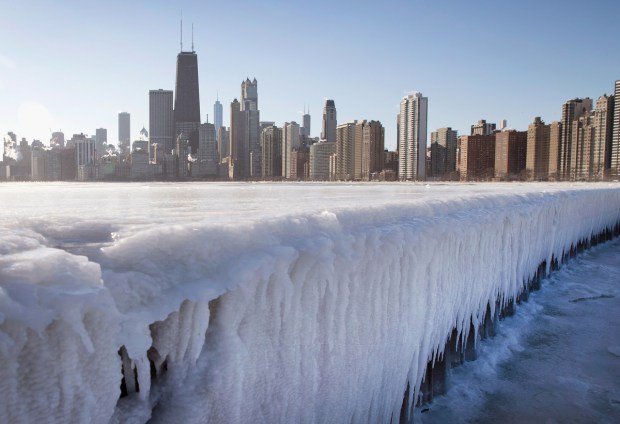
Ice builds up along North Avenue Pier in Chicago while temperatures hovered around zero degrees Fahrenheit on January 7th, 2015. Scott Olsen/Getty Images
For me, I don’t believe my interest in wx came from one specific event, but I do remember growing up in the Midwest and living through some pretty intense winter storms. Many of these storms would drop 10 to 20 inches of snow, bring dangerously cold conditions and leave most people stranded in their homes for days.
In general, wx in the Midwest can be pretty intense. This region of United States can have intense blizzards in the Winter and sweltering heat waves in the Summer. During the Spring and Fall, strong thunderstorms and tornadoes can be a serious threat. The wx can also be quite nice. Temperatures comfortably in the 70s and 80s in the summer, beautiful cool and crisp days in the Fall and Spring, and a few mild days in the Winter.
If I were to put a year on when I noticed my interest in wx, it would have been around 1998, or age 12. At that time, I would visit my grandparents a lot and find myself watching The Weather Channel (TWC), especially when severe weather was occurring. For most of my childhood, outside of the local newscast, TWC was the main venue to get wx news.
A long with TWC, I would watch a NASA cable channel that provided a live feed of Earth from space. The narrator on this channel would point out wild fires that were visibility across other parts of the world, as well as hurricanes and severe wx systems visible from space.
I would also watch local news for wx coverage. I remember 1998 being a big year for wx as there was a very strong El Nino occurring. For those who don’t know, an El Nino represents the warm phase of the El Nino/Southern Oscillation (ENSO), which is an oscillation of the atmospheric and ocean temperatures of the tropical Pacific Ocean, west of South America. This oscillation can affect global weather patterns, and for the Midwest, El Ninos typically mean milder winters for the region. Every Chicago tv met covered the El Nino and its impact on our weather.
It wasn’t until I entered high school and was forced to seriously consider what I wanted to do for a career that I decided on a career as a met. And I thought I could be a good met. I enjoyed math, physics and chemistry. I was a good public speaker and generally enjoyed people. These were important skills needed to become a met, especially a broadcast met. That decision eventually led me to where I am today.
 A Met's World